Houston Expects First Pass of Beryl Debris Collection to Wrap Up by Early to Mid-August
City officials say crews are about halfway through the first round of cleanup, having hauled away more than a million cubic yards of vegetative debris since collection began 17 days ago.
By Kendra Konchanuk ·
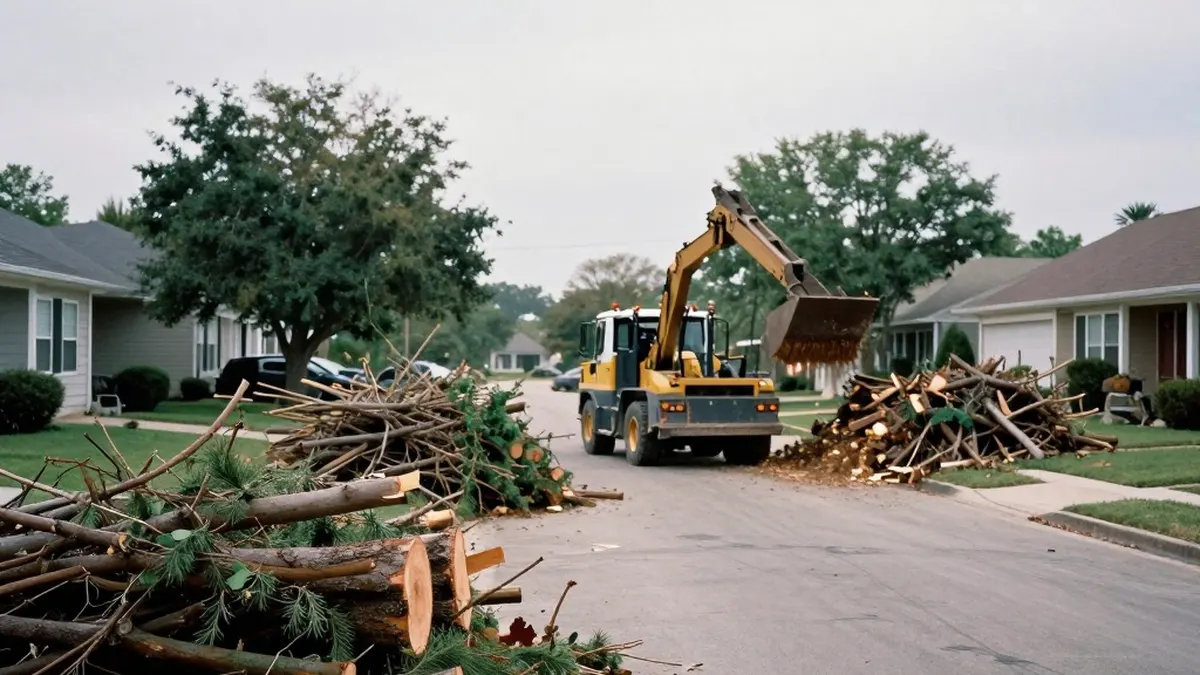
The City of Houston expects to finish its first pass of debris collection by early to mid-August, roughly 30 days after crews began hauling away downed trees, fallen limbs and other storm debris from curbsides in the wake of Hurricane Beryl.
Mark Wilfalk, director of the city's Solid Waste Management Department, said on Houston Matters with Craig Cohen on Monday that crews are about halfway through the first pass. In the first 17 days of collection, the city has picked up more than a million cubic yards of vegetative debris. "We've been going strong for about 17 days," Wilfalk said. "We lost about four or five days due to inclement weather, and we're already at a million cubic yards."
Wilfalk said the city's goal is to complete the first pass within 30 days, with city crews and three other contract services working on the effort. "People should expect to see a majority of that debris gone within the next three and a half weeks," he said.
He noted that debris removal is slower and more granular than restoring electricity, where a single repair can bring many homes or entire neighborhoods back online. "Each home has to have individual service, and it requires a certain level of individual attention," he said. Cutting up trees that are 60, 70 or probably 100 years old, he added, makes the work lengthy and calls for patience.
Wilfalk compared the post-Beryl cleanup with the aftermath of the derecho in May, which knocked out power and scattered debris across parts of the city. In a little over a month, he said, the city collected about 1.7 million cubic yards of debris from that storm, which affected only about half of Houston. After Beryl, the city is nearing the same total in just over two weeks. "So, it's definitely a monumental task that we're taking on," he said.
Nearby Sugar Land is also about halfway through its first pass, which was projected to take four weeks. Dawn Steph, the city's executive director, told Houston Matters that Sugar Land activated its contractors before Beryl arrived, which let workers start collecting debris on Friday, July 12, the day after the storm's passage.
The city has since brought in additional equipment and hopes to finish its first pass by the three-week mark, around Aug. 2. "Worst case is four weeks for first pass," Steph said. She described that timeline as realistic given the volume involved. "You've got huge trees that have fallen across our city and that are being brought to the curb," she said. "There's really no way to speed that up when every house has their almost entire front yard full of trees and debris."
Residents have other options in Houston. The city offers an interactive map showing which sites have already had debris picked up, and it operates a handful of neighborhood drop-off sites for people who are able to haul their own debris. Wilfalk said the city may open more of them. "We may even consider opening more just to give residents the opportunity to drop that off or bring it to a location if they need to," he said.
Sugar Land also maintains an interactive map but currently has no drop-off sites. Steph said that is something the city will consider "in the future for future events."
Source: Houston Public Media